
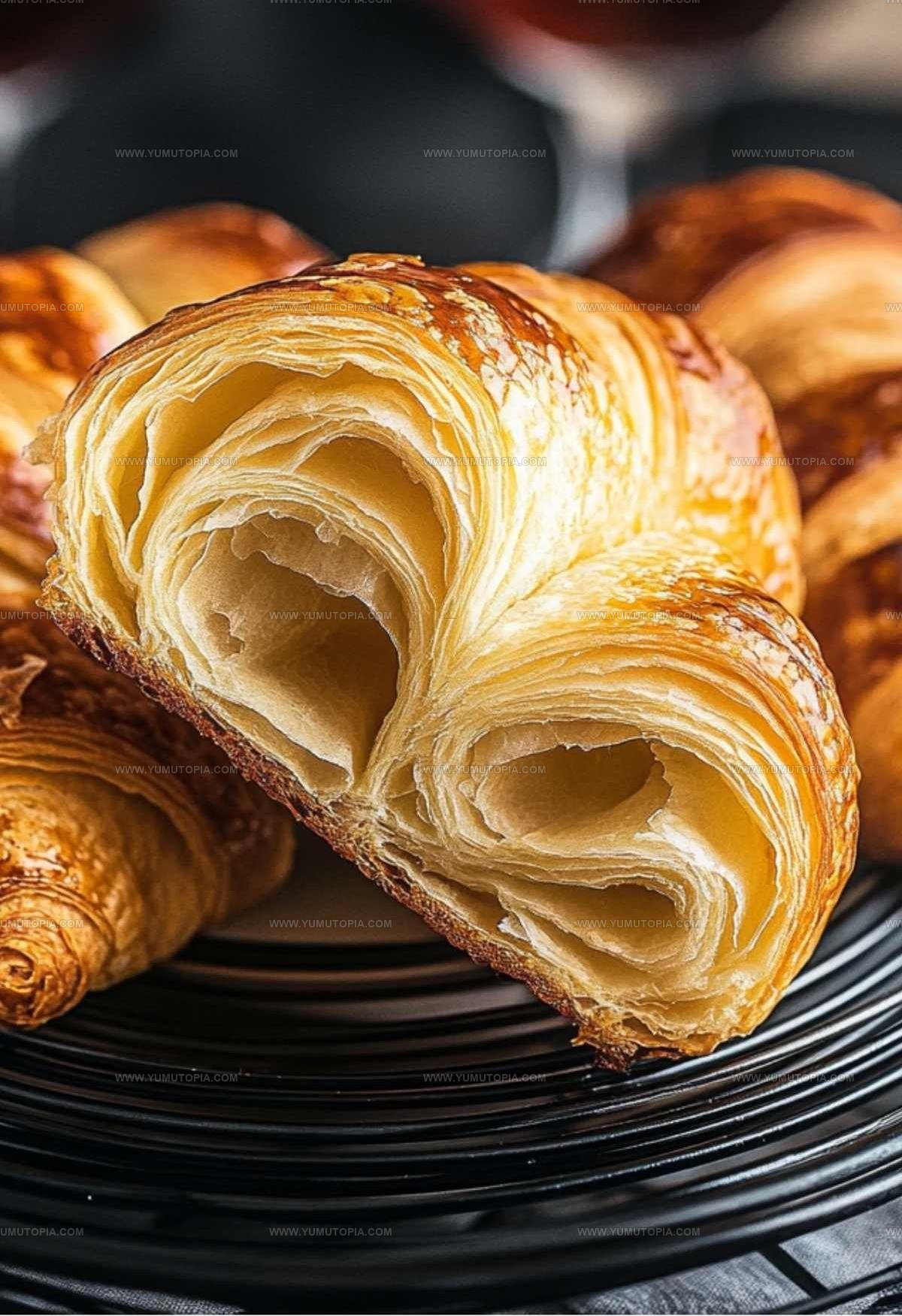
Buttery Croissant Recipe For Perfect Flaky Layers At Home

Homemade croissants step-by-step might sound intimidating, but baking them from scratch is absolutely within reach for anyone willing to dedicate a little time and patience.
Flaky layers of buttery pastry represent one of the most rewarding projects you can tackle in the kitchen, offering an experience that connects you with centuries of baking tradition.
The process teaches valuable skills while filling your home with an aroma that no store-bought version can match.
What seems complex becomes manageable once you understand the rhythm of folding, resting, and shaping.
Success depends more on careful timing than on advanced techniques, making the journey accessible even for less experienced bakers.
Every golden, crisp bite brings satisfaction that goes far beyond what any bakery counter offers.
Why Homemade Croissants Are Worth the Effort
Which Ingredients Are Needed for Homemade Croissants
Main Ingredients:Supporting Ingredients:Finishing Ingredient:What Tools You Need to Make Homemade Croissants
How to Make Homemade Croissants
Activate the Yeast
Grab a large mixing bowl and pour in 160 g of lukewarm milk. Sprinkle 2 1/4 teaspoons of instant yeast over the milk and let it sit for about 5 minutes until it gets slightly foamy.
Mix the Dough Base
Add 120 g of water to the yeast mixture. Toss in these ingredients:
Knead the mixture until it becomes a smooth, soft dough that feels elastic when you stretch it.
First Dough Rise
Cover the bowl with a clean kitchen towel and let the dough rest in a warm spot for about 1 hour. You want it to double in size and look puffy.
Prepare the Butter Block
Take 250 g of unsalted butter and 1 1/2 tbsp of flour. Smoosh them together on a piece of parchment paper until they form a neat square about 1/2 inch thick. Wrap and chill in the refrigerator for 30 minutes.
Create the Butter Layers
Roll out your dough into a large rectangle. Place the chilled butter block in the center and fold the dough over it like an envelope. Roll it out gently, creating thin layers of butter and dough.
Fold and Chill
Fold the dough into thirds, like a letter. Wrap it in plastic and refrigerate for 45 minutes. Repeat this folding and chilling process two more times.
Shape the Croissants
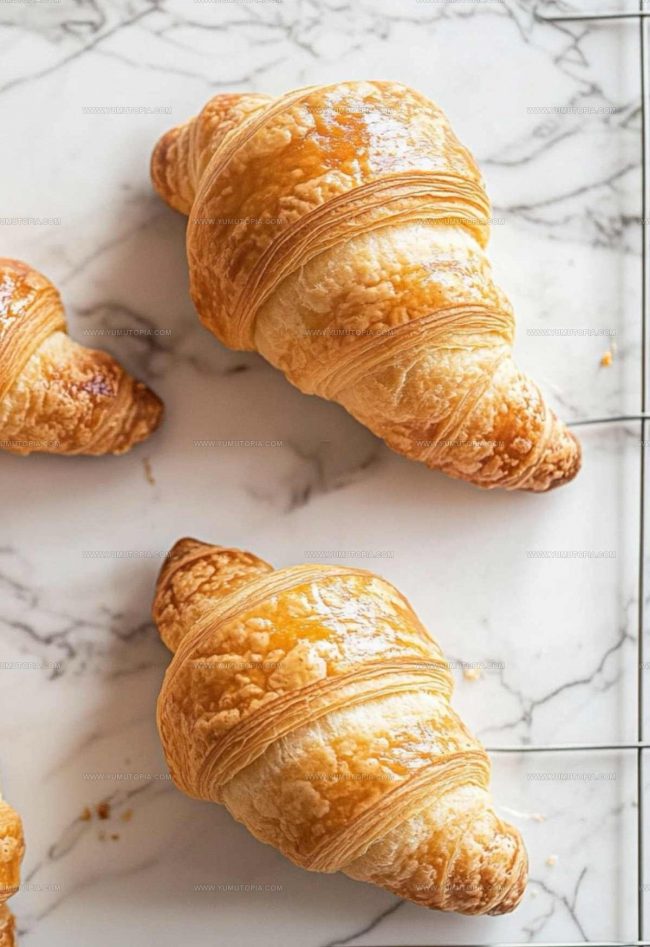
Roll the dough into a large rectangle about 1/4 inch thick. Cut into triangles. Starting from the wide end, roll each triangle into a crescent shape.
Final Rise
Place the croissants on a baking sheet. Let them sit in a warm area for about 45 minutes until they look puffy and almost doubled.
Prepare for Baking
Whisk 1 large egg and brush it gently over each croissant. Preheat the oven to 400°F.
Bake to Golden Perfection
Bake the croissants at 400°F for 15-18 minutes. Watch for a deep golden brown color that makes your kitchen smell amazing.
Which Tips Perfect Homemade Croissants
Best Variations for Homemade Croissants
Best Ways to Serve Homemade Croissants
Best Ways to Store Homemade Croissants
Homemade Croissants Frequently Asked Questions
Can beginners make croissants at home?
Absolutely! With patience and practice, anyone can master croissant-making. The key is following each step carefully and not rushing the process.
Why do croissants need so many folding steps?
These layers create the signature flaky texture. Each fold traps butter between dough layers, which produces those delicate, buttery pastry sheets when baked.
Does the butter temperature matter?
Completely! Your butter block should be cold but pliable. If it’s too warm, it will leak during rolling. If too cold, it’ll break instead of spreading smoothly.
What if my dough tears during folding?
No worries. Patch small tears with a bit of flour and continue. Gentle handling prevents major rips that could ruin your laminated dough.
Can croissants be made ahead of time?
Definitely. You can prepare the dough and do initial shaping, then refrigerate overnight before the final rise and baking.
How do professionals get such perfect croissant shapes?
Practice creates precision. Rolling the triangles evenly and keeping consistent tension while shaping makes beautiful, uniform croissants.
Homemade Croissants Recipe
- Total Time: 2 hours 25 minutes
- Yield: 8 to 10 1x
Description
Crafting homemade croissants requires patience and butter-layered precision that makes your kitchen smell like a Parisian bakery. Flaky, golden crescents emerge from your oven after careful folding and rolling, ready to delight breakfast companions with their buttery, delicate charm.
Ingredients
Primary Ingredients:
- 470 g all-purpose flour
- 250 g unsalted butter
- 160 g whole milk
- 120 g water
Supporting Ingredients:
- 50 g granulated sugar
- 30 g unsalted butter
- 2 ¼ teaspoons instant yeast
- 1 ½ teaspoons salt
- 1 ½ tablespoons all-purpose flour
Egg Wash:
- 3 large eggs
Instructions
- Activate 2 ¼ teaspoons of instant yeast in 160 g of lukewarm whole milk. Ensure the milk temperature reaches exactly 110°F to help your yeast wake up perfectly.
- Mix in 120 g of water and incorporate 470 g of all-purpose flour, 50 g granulated sugar, 1 ½ teaspoons salt, and 30 g room temperature butter. Knead the mixture until your dough transforms into a smooth, elastic texture.
- Cover your dough and let it rest at room temperature for 1 hour, allowing it to rise and develop rich flavor profiles.
- Create a butter block by combining 250 g unsalted butter with 1 ½ tablespoons flour. Shape into a precise 6-inch square on parchment paper.
- Refrigerate your butter block for 30 minutes to maintain a cool, firm consistency that will layer beautifully in your dough.
- Roll your dough into a 12-inch square on a lightly floured surface. Place the chilled butter block at a 45-degree angle in the center of your dough.
- Fold the dough corners over the butter, creating a sealed envelope. Roll the package into a 15-inch rectangle, maintaining even thickness.
- Perform the first “turn” by folding the dough into thirds, like a business letter. Rotate 90 degrees and repeat the rolling process.
- Wrap your dough and chill for 1 hour. Repeat the turning and folding process two more times, chilling between each turn.
- After your final turn, let the dough rest overnight in the refrigerator to develop complex flavors.
- Roll the dough to ⅛-inch thickness and cut into triangles approximately 4 inches wide at the base.
- Gently stretch each triangle, then roll from the wide end to the point, creating a classic croissant shape with a slight curve.
- Place croissants on a parchment-lined baking sheet and let them prove at room temperature for 1-2 hours until puffy and doubled in size.
- Preheat your oven to 400°F. Brush croissants with one beaten egg, ensuring a complete, glossy coating.
- Bake for 15-18 minutes, rotating the pan halfway through, until your croissants achieve a deep golden-brown color and flaky exterior.
Notes
- Use high-quality, cold butter for the best flavor and texture in your laminated dough.
- Keep everything cold during the folding process to ensure distinct butter layers that create flaky croissants.
- Roll the dough on a cool surface and work quickly to prevent butter from melting into the dough.
- For gluten-free options, substitute regular flour with a specialized pastry gluten-free blend and add xanthan gum for structure.
- Prep Time: 2 hours
- Cook Time: 20-25 minutes
- Category: Pastries
- Method: Baking
- Cuisine: French
Nutrition
- Serving Size: 8 to 10
- Calories: 333 kcal
- Sugar: 6 g
- Sodium: 226 mg
- Fat: 22 g
- Saturated Fat: 14 g
- Unsaturated Fat: 7 g
- Trans Fat: 0.5 g
- Carbohydrates: 28 g
- Fiber: 1 g
- Protein: 6 g
- Cholesterol: 86 mg
Madison Wyman
Recipe Developer & Food Storyteller
Expertise
Recipe Research and Adaptation, Food Writing and Cultural Storytelling, Sustainable and Ethical Sourcing, Dietary Adaptations (e.g., gluten-free, plant-based)
Education
Oregon Health & Science University
Portland Community College
Madison’s passion for flavor and culture ignited amidst the rich Southern cooking traditions of her upbringing, where cherished family recipes told delicious tales.
Armed with a Master’s in Food Systems and Society from Oregon Health & Science University and a Culinary Arts Certificate from Portland Community College, Madison truly excels at transforming rich, intricate flavors into dishes that are both approachable and heartfelt.
For her, cooking is a vibrant blend of science, art, and heritage – a powerful way to connect us to our roots and each other. Her recipes invite you to delve deeper, uncovering the fascinating stories woven into every ingredient.